

Chinese President Xi Jinping traveled to Washington in September 2026 to meet with U.S. President Donald Trump for the second time this year. Despite the fact that the United Nations General Assembly is taking place simultaneously in New York, drawing almost 130 heads of state and government to the U.S. metropolis, it is becoming increasingly clear that we live in a G2 world — a world dominated by the two superpowers, the United States and China.
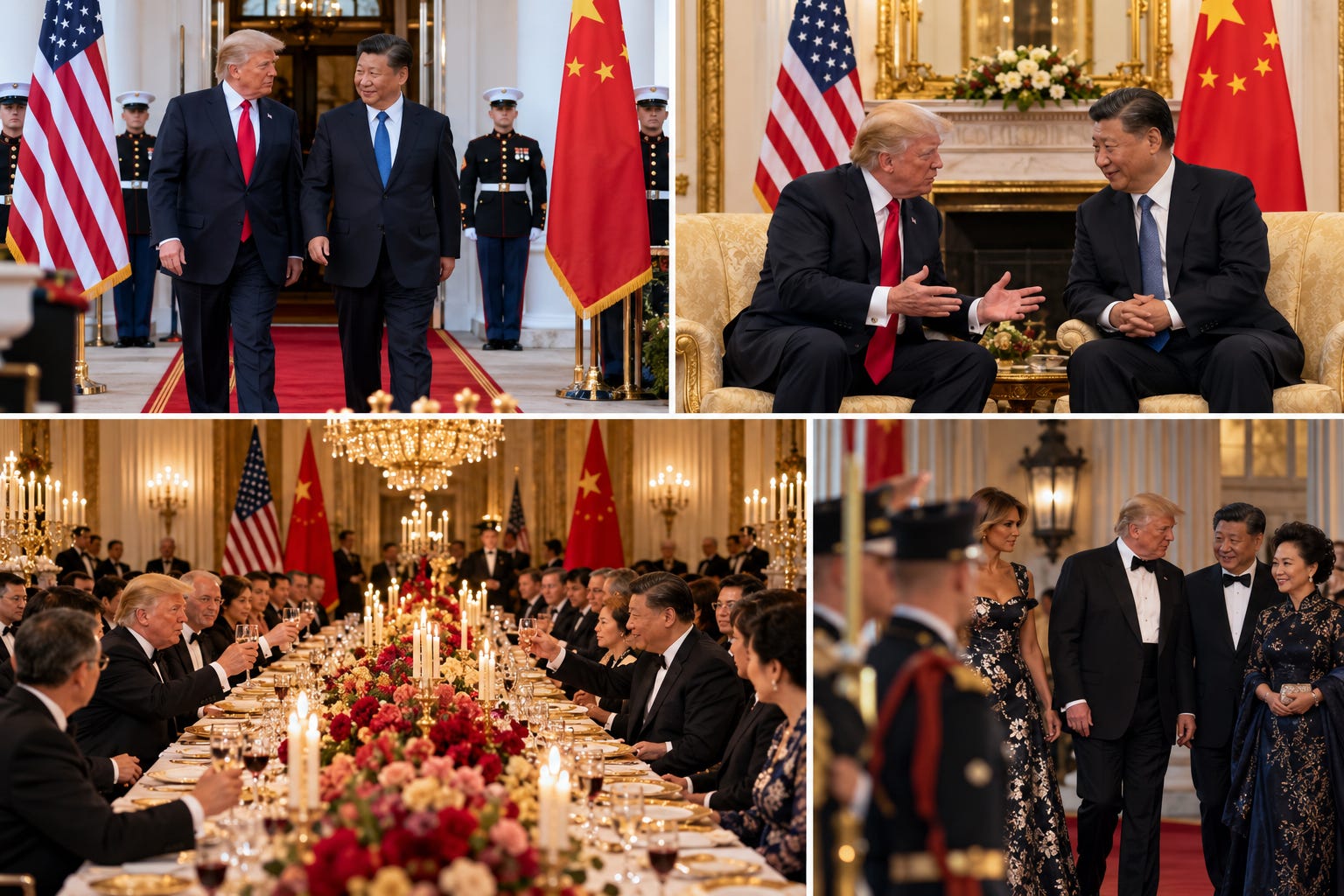
China repeatedly speaks of the ideal of a multi-polar world that would also include Europe, India, Brazil, and other regional centers of power. But fundamentally, neither Washington nor Beijing has any interest in sharing the world stage with these middle powers. Instead, each side seeks to overtake its principal rival. So far, however, neither has clearly succeeded — economically, militarily, or technologically. In almost every area the U.S. is still slightly ahead though essentially the two superpowers are engaged in a head-to-head race, not least in artificial intelligence (AI).
The U.S. continues to be also narrowly ahead in this field, but given the rapid development of new AI models, that could change at any time. In the talks preparing for the summit, led by U.S. Treasury Secretary Scott Bessent and Chinese Vice Premier He Lifeng, the two sides agreed to propose to their leaders the establishment of a U.S.-China dialogue on AI. Similar to the “Red Telephone” during the Cold War, a warning mechanism is also to be developed so that both countries can intervene in time should the AI technology models become dangerously autonomous.
But this is all window dressing. Ultimately, neither Donald Trump nor Xi Jinping has any interest in slowing the development of AI or building in serious safety mechanisms, since doing so could give its rival an advantage in the escalating AI race.
Persistent Mistrust
The two powers deeply distrust each other. While the Chinese continue to show a degree of respect and recognition — albeit declining — for the enormous power of the United States, in the U.S. it remains routine to speak of China (rather than Russia!) as the nation’s greatest enemy.
Particularly in Congress, but also among large sections of the American population, China continues to be viewed with great suspicion. Trump partly owed his first electoral victory to the demonization of China. In 2016, he declared that China was “raping” the United States through its huge trade surplus and sought to replace it as the world’s leading economic power. These were still Trump’s stated fears at the beginning of his second term.
In early April 2025, he imposed tariffs of up to 145 percent on Chinese imports, although he soon reduced them substantially. China, for its part, imposed high tariffs on goods from the United States. Above all, however, China drastically restricted exports of rare earths critical minerals to the United States, thereby creating serious problems for many industries, including the automobile, weapons, and ammunition sectors. Trump quickly backed down.
A Thaw Begins
Since then, a gradual thaw has developed between China and the United States. Trump had to realize that for the first time he had encountered a serious opponent in Xi Jinping who could not simply be pushed around as easily as most European countries.
At an initial meeting of less than two hours in Busan, South Korea, in October 2025, the two presidents signed a trade agreement lasting one year. The United States agreed to reduce the average tariff rate on Chinese imports from 57 percent to 47 percent and to suspend the imposition of retaliatory tariffs on Chinese goods for one year (in the meantime the average tariff rate on China has fallen to 23 per cent).
In return, China promised to suspend export controls on rare earths and high-tech products for one year as well and to dramatically increase imports of soybeans and other agricultural products from the United States.
Two months later, Trump allowed the semiconductor company Nvidia to export one of its most advanced high-performance chips to China. This not only gave a boost to China’s AI industry but also earned Trump the goodwill of Xi.
The U.S. president was soon thereafter — in May 2026 — received in Beijing for a rather lavish state visit. Since then, trade and AI relations between China and the United States have continued to ease.
At the recently held imposing “Xiangshan Forum” on security policy in Beijing, organized by the Chinese military — it is China’s answer to the Munich Security Conference and Singapore’s annual Shangri-La Dialogue — a senior U.S. officer told me that for several months there had been extremely friendly contacts with the People’s Liberation Army (PLA) in Beijing. Conversations are taking place on an almost daily basis. Occasionally, she said, U.S. officials even meet with Chinese generals for a convivial evening.
There has not been such a close relationship in U.S.-Chinese military relations for a very long time. Nevertheless, it was recently revealed that China does not hesitate to provide Iran with precise electronic targeting information for attacks on U.S. ships in the Persian Gulf.
Friendly meetings in the White House
Xi Jinping’s visit to Washington will proceed relatively harmoniously. The poor economic situation in both countries — including high youth unemployment and low consumption in China and escalating inflation in the United States — will induce Trump and Xi to extend the trade agreement of October 2025, which is due to expire.
The release of Jimmy Lai, the imprisoned and seriously ill dissident from Hong Kong, will probably be discussed only behind closed doors.
The same is likely to apply to Trump’s and Xi Jinping’s policy toward Taiwan - including U.S. arms deliveries to Taipei - as well as regarding the policy toward the uninhabited islands, reefs and rocks in the South China Sea claimed by China and several other countries.
Given the extremely dangerous global situation and the still fragile relationship between the United States and China, one can only hope that for the time being at least both countries will maintain the status quo regarding Taiwan and the South China Sea. Kicking the can down the road may not be the worst outcome of the conversations held in the White House.
China as a Pole of Stability
The Chinese leadership has gained considerably in self-confidence in recent years, something that will be impossible to overlook at the Trump-Xi summit in Washington. But the U.S. president’s erratic foreign policy has certainly contributed to this development.
The entirely unnecessary war with Iran and Washington’s continuing support for the Netanyahu government’s brutal actions in the Gaza Strip have significantly damaged the global image of the United States.
In the Global South, but also in many Western countries, China is now paradoxically celebrated as a pole of stability, rationality, and reliability. Yet Beijing has no qualms about continuing, at least indirectly, to enable Russia’s war of aggression against Ukraine and — as mentioned — supporting the regime in Tehran.
Trump ignores all of this. He has become one of Xi Jinping’s great admirers, and right now his priority is to ensure a successful state visit by the strongman from Beijing.
As always, very clear and perceptive. Thank you for this. Norbert Finzsch