

Ultimately, Donald Trump thinks like a real-estate developer. After all, that is what he was before he became one of America’s best-known celebrities through the television series The Apprentice, which first aired in 2004.
As president, Trump still tries to reorganize everything around him. Cost seems to play little role, regardless of how high the price may be. Despite the astronomically expensive war in Iran, the U.S. military’s ammunition shortages, and the ongoing war in Ukraine, Trump continues to find time to have things demolished and rebuilt in Washington and at the White House.
He still wants to construct his controversial 90,000-square-foot ballroom, with room for 1,000 guests, on the site of the historic East Wing, which was simply demolished. The Supreme Court must now decide whether the project is lawful. Trump has had part of the Rose Garden at his official residence paved over, and a large helicopter landing pad is being built nearby, reportedly in time for Chinese President Xi Jinping’s visit at the end of September.
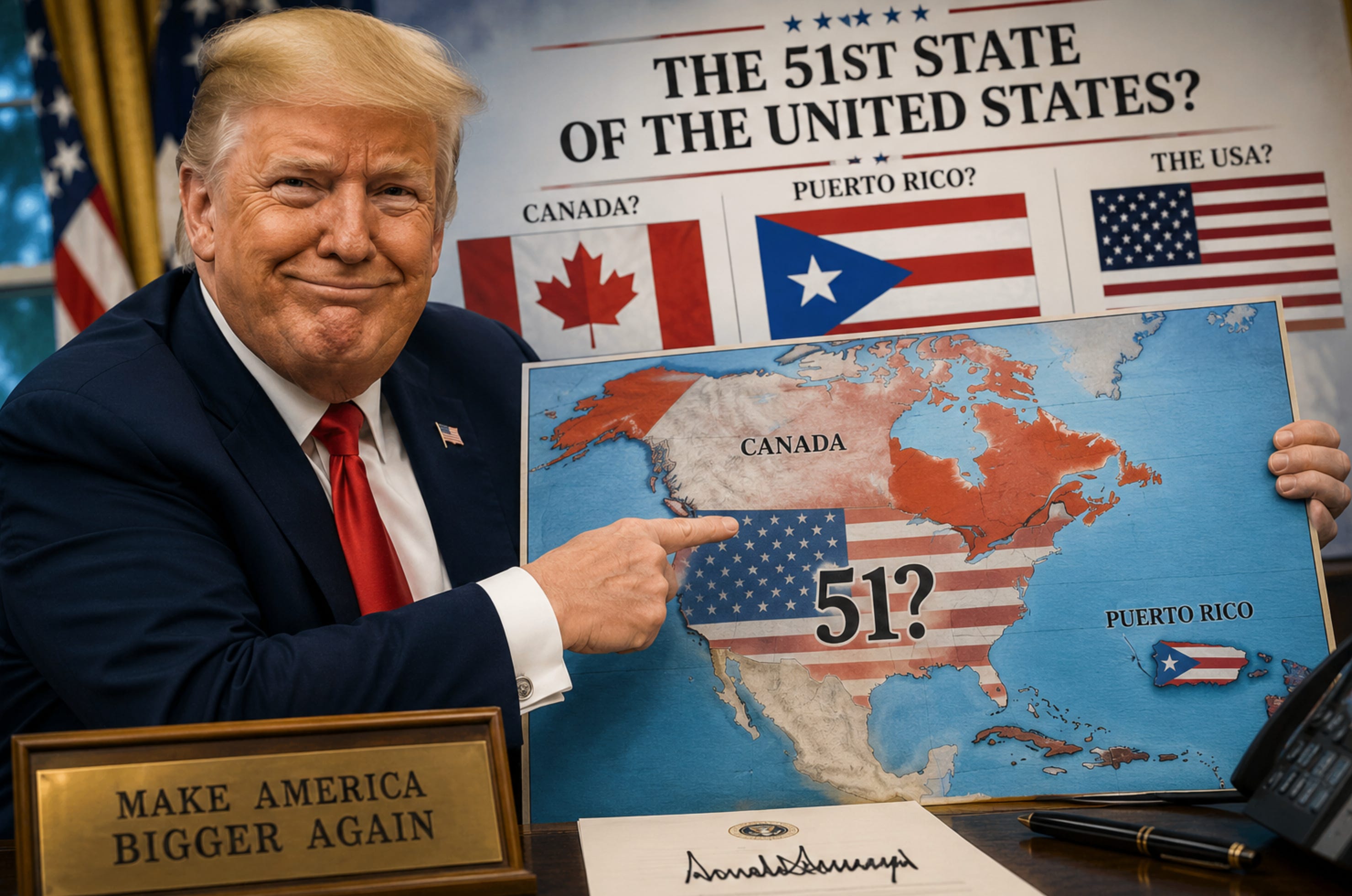
Trump wants to create the 51st state of the U.S. - Puerto Rico is ready
As is well known, Trump also wants to enlarge U.S. territory by acquiring Greenland or even neighboring Canada - much to the displeasure of the people who live there and their governments. Yet there is a beautiful Caribbean island nearby, only about a four-hour flight from Washington, whose inhabitants would like nothing more than to become the 51st state of the United States: Puerto Rico.
With a population of 3.2 million, Puerto Rico is by far the largest of the five inhabited—and nine uninhabited—territories that are part of the United States but somehow do not fully belong to it. The other four inhabited territories, with populations ranging from 40,000 to 170,000, are American Samoa, Guam, the Northern Mariana Islands, and the U.S. Virgin Islands.
People born in these territories are U.S. citizens, hold American passports, use the U.S. dollar as their currency, and are subject to U.S. laws. Yet they do not pay federal income tax and are excluded from many federal social programs. Most importantly, they cannot vote in presidential or congressional elections.
A Spanish Colony for Almost 400 Years
When Christopher Columbus landed on the Taíno-inhabited island in 1493, Puerto Rico came under Spanish rule. With the help of the impressive fortifications in San Juan, Puerto Rico’s largest city, Spain was able to defend its Caribbean possession against its European rivals for almost 400 years.
The island soon developed into an important exporter of coffee, tobacco, and sugar. At the same time, however, the Puerto Ricans’ desire for independence grew, prompting Spain to grant the island autonomy in 1897.
Only a few months later, however, Puerto Rico—as well as the Philippines and Guam—was conquered by the United States during the Spanish-American War. Through a brief but aggressively waged military campaign, the United States succeeded in permanently driving Spain out of the Caribbean and the Western Hemisphere.
While the Philippines did not gain independence until 1946, after almost 50 years of American colonial rule, Puerto Rico, situated in the U.S. backyard, was initially governed for two years by an American military administration.
The passage of the Foraker Act in April 1900 then established Puerto Rico as a U.S. territory governed by its own civilian administration. Although the island henceforth had a freely elected bicameral legislature, the U.S. president appointed the governor and many other public officials.
In 1917, Congress granted Puerto Ricans U.S. citizenship. The island’s strategic importance had increased considerably with the opening of the Panama Canal. With the wave of decolonization following World War II, pressure on the United States to improve Puerto Rico’s status grew.
Congress therefore granted Puerto Rico the right to elect its own governor in 1947. A new constitution introduced a few years later established Puerto Rico as a U.S. commonwealth. The island thereby acquired substantial domestic autonomy and self-government, which also benefited its successful transformation from an agricultural society into an industrial manufacturing economy.
Tax incentives and inexpensive labor attracted many U.S. companies to Puerto Rico. The pharmaceutical industry, for example, experienced a major boom and remains an important part of the island’s economy.
The Debate Over Statehood
For years, Puerto Rico has been engaged in an intense debate over whether the island should become the 51st state of the United States.
Statehood would significantly improve Puerto Rico’s economic prospects and attract considerably more investment. In nonbinding referendums held in 2012, 2017, 2020, and most recently in November 2024, Puerto Rican voters expressed clear majorities in favor of statehood.
Ultimately, however, the decision rests with Congress. Only Congress has the authority, through a complicated process, to create a new state and admit it to the Union. The last time this happened was in 1959, when Alaska and Hawaii joined the United States.
Why is there a lack of interest in DC for Puerto Rican statehood?
Yet the deeply divided and largely paralyzed Congress in Washington pays Puerto Rico little attention—just as the man in the White House does.
Much like the long-running debate over whether Washington, D.C., should become a state, Republicans fear that Puerto Rico would give the Democratic Party two additional Senate seats and numerous seats in the House of Representatives.
Trump, meanwhile, would rather annex vast territories such as Canada and Greenland—or the lucrative Panama Canal area—than concern himself with rather small and non-white Puerto Rico. After all, the Caribbean island is only about the size of Cyprus.
Puerto Rico is also relatively poor, despite its extraordinary natural beauty. Following a prolonged recession from 2006 to 2017, the economy has gradually begun to recover, despite current water shortages, not least because of growing tourism.
Yet the devastating effects of Hurricane Maria in September 2017 and the COVID-19 pandemic are still clearly felt.
Still, it is high time for Puerto Rico to become the 51st state and to be fully and equally integrated into the United States. Trump should not keep talking about crazy ideas such as annexing Canada and Greenland but pay some attention to Puerto Rico.
Thanks to bring a honest description of Puerto Rico's struggle to be the 51st State. From Marilou Rivera / Estrella 51 Blogspot.