
Western intelligence cooperation is in crisis: The 'Five Eyes' are not working together as closely as they used to do
This is a slightly revised English version of an essay which was published in the German daily newspaper 'Kölner Stadtanzeiger' on July 11, 2026.

The recent NATO summit in Ankara on July 7-8, 2026, turned out to be better than expected by many observers, though standards are low these days regarding what counts as a successful summit. Regarding support for Ukraine the NATO allies again seemed to sing from a similar hymn sheet. U.S. President Donald Trump also appeared to be in a fairly good mood and did not walk out of the meetings. Still Trump continued to be miffed that many European NATO countries wanted nothing to do with the unnecessary war against Iran and had initially refused to support the U.S.
Once again Trump also brought up Greenland. He declared that this Danish autonomous territory was not important for Denmark but it was crucial for the U.S. for strategic reasons. Washington therefore ought to acquire and control the huge island as only his country was capable of providing for its security. The Danish Prime Minister and her EU colleagues were not amused.
The continued existence of NATO and the cohesion of transatlantic relations continues to hang by a thread. And even in an area largely hidden from public view, Trump’s erratic policies and the growing mistrust among transatlantic allies are having an increasingly negative impact on western cooperation and unity. The traditionally strong cooperation among Western intelligence agencies is also in a deep crisis.
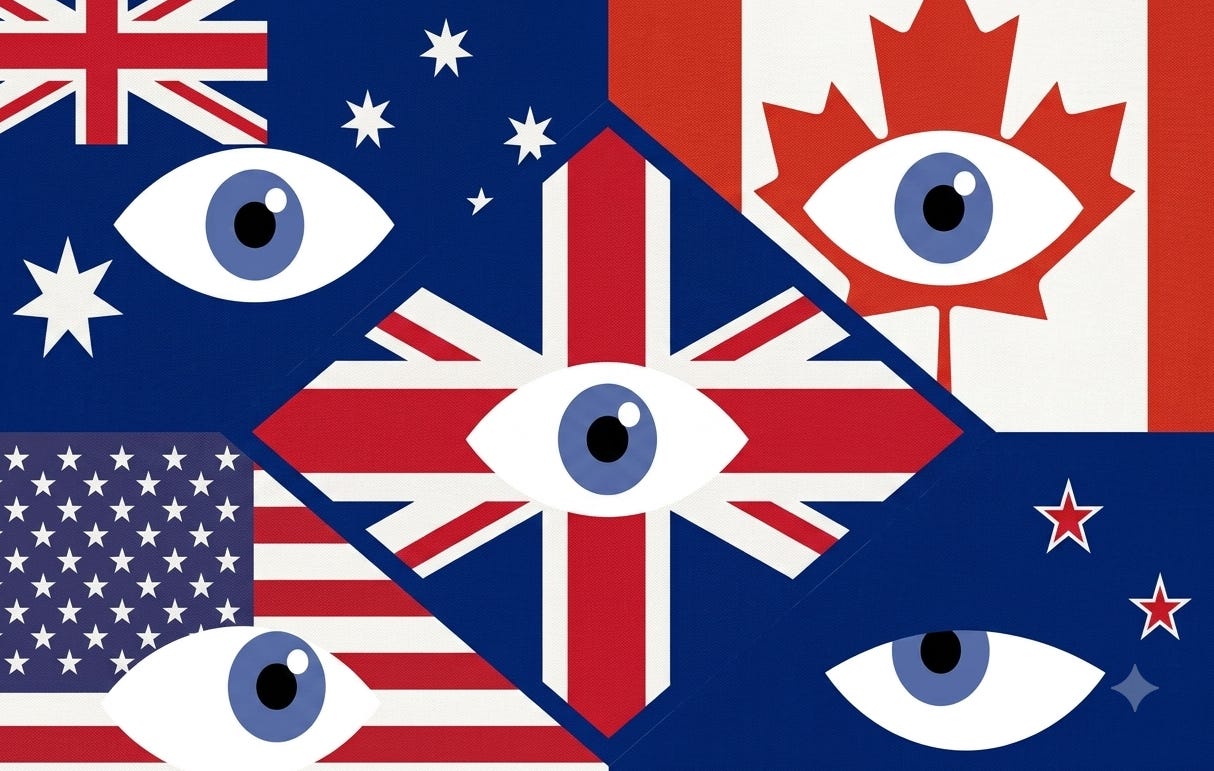
The “Five Eyes” - backbone of Western intelligence cooperation
The backbone of Western intelligence cooperation is the informal collaboration of the so-called “Five Eyes”—the close intelligence partnership among the English-speaking countries: the U.S., the U.K., Canada, Australia, and New Zealand. This cooperation dates back to the close collaboration between Washington and London during World War II, when experts from both countries, after many protracted attempts, succeeded in cracking the code for the Nazi regime’s encrypted messages.
On March 5, 1946, Winston Churchill delivered his important “Iron Curtain” speech at Westminster College in Fulton, Missouri. On the same day, the no less crucial UKUSA Agreement on intelligence cooperation during the Cold War was signed in Washington, D.C. A few years later, Canada, Australia, and New Zealand joined the agreement.
The foundation for the increasingly close cooperation among these countries—united by similar democratic systems of government—was the mutual trust that their elites placed in one another. They could rely on the fact that the top-secret information exchanged would indeed remain secret. London and Washington, in particular, worked so closely together during the Cold War that the U.S. covered half the costs of the important British military base at Akrotiri in Cyprus, which monitored the Middle East.
It was not surprising that no continental European country became part of the “Five Eyes.” Ultimately, the U.S. had little confidence in the discretion and reliability of French and Italian intelligence services. Although the West German Federal Intelligence Service (BND) was among the best intelligence organizations in the world during the Cold War, West Germany (and West Berlin) was teeming with agents and spies. Admission to the “Five Eyes” club was never on the agenda. Even though every effort is currently being made in Berlin to modernize the BND—with its 6,500 employees it is one of the largest intelligence services in the world —and to bring it up to the highest standards, particularly in the cyber sphere, it is unlikely that Germany will be admitted to the “Five Eyes” club.
UK intelligence remains exceptionally strong
While “Five Eyes” cooperation relies on the enormous intelligence capabilities of the United States—capabilities unmatched by any other country in the world—the capabilities of the British intelligence services, coordinated through the Government Communications Headquarters (GCHQ), remain exceptionally strong. For example, during the 2016 U.S. election campaign, London intercepted electronic communications between the Trump campaign headquarters in New York and Putin’s Russia—something Trump has never forgiven the British for. From the perspective of Trump’s team, this has significantly weakened the traditional Anglo-American foundation of trust.
But London, too, has become considerably more cautious when it comes to sharing intelligence with Washington. Ever since the Trump administration began regularly bombing alleged drug-smuggling boats in the Caribbean—instead of arresting the smugglers and bringing them before a judge, as required by international law—London has refused to pass on intelligence from the region to Washington. The British government’s initial refusal to make its military bases available to the U.S. for bombing Iran further undermined the long-standing foundation of trust in the “special relationship.”
The crisis of western intelligence since 2013
But the crisis facing Western intelligence agencies and the dwindling trust in the reliability of the U.S. began even before Donald Trump. In 2013, former U.S. intelligence contractor Edward Snowden exposed the practices of the “Five Eyes” alliance, which used the ECHELON network—established as early as 1971—to sift through and store vast amounts of electronic information. This affected not only hostile countries, but also their own citizens and allied nations. Even German Chancellor Angela Merkel’s phone had been tapped for years by the U.S. National Security Agency (NSA).
Ten years later, in 2023, a Pentagon employee posted top-secret information from the U.S. Department of Defense regarding the military situation in Ukraine on a publicly accessible Discord server primarily used by video gamers. Since then, the U.S. has become overly cautious and has been sharing less and less material with the “Five Eyes.” The U.S. government now classifies a large portion of its intelligence as NOFORN—not for foreign distribution.
Paradoxically, however, highly classified information is sometimes handled very carelessly in the U.S. During his first term, Trump shared confidential “top secret” information from Israeli intelligence with Russian Ambassador Sergei Kislyak during a conversation in the Oval Office. Furthermore, the unintentional inclusion of a journalist in an information exchange via the Signal messaging service between Defense Secretary Pete Hegseth and several cabinet colleagues in March 2025 further undermined confidence in the reliability of the U.S.
Added to this is the rhetoric of the Trump administration, which regularly treats allied countries condescendingly and as of little importance, and views professional diplomats and intelligence experts as expendable. All of this has undermined the “Five Eyes” alliance’s willingness to cooperate confidentially with the U.S.
Imminent dangers and what to do
Yet just a few weeks ago, the “Five Eyes” cyber experts warned that large-scale AI attacks by Russia and China on the critical infrastructure and defense facilities of Western countries were to be expected in the near future. Warnings from many intelligence agencies that Moscow is likely to launch a military attack on a NATO country such as Poland or Estonia in the near future are also growing increasingly frequent. It is tragic that, at this very moment, mutual trust among transatlantic allies and confidence in the reliable cooperation of the “Five Eyes” intelligence agencies have sunk to an all-time low. This ought to be rectified as a matter of great urgency on both sides of the Atlantic.
It seems to me that Europe and Canada are doing just fine, with new défense agreements and intelligence collaborations, and many contracts and joint ventures for procurement.
The fact that none of them trust Trump’s America, not least because Trump and his team seem to alternate between working for Putin and working for Netanyahu, can be of no surprise at all!
The sooner Europe and Canada build their independent security infrastructure with zero critical dependence on America, the better.